Ancient Mariner
The Rime of the Ancient MarinerThe Ancient Mariner is the poem’s central survivor, whose voyage becomes a lasting burden and whose telling of it changes a Wedding-Guest. Introduced as an old sailor who stops one of three passersby, he recounts a passage from ordinary seafaring into supernatural peril: a violent storm drives the ship onward, the Albatross appears, and he shoots it with a Crossbow. His later blessing of the water-snakes marks a decisive inward change, but not an end to his suffering. At home, pain compels him to tell the story again, and its final teaching joins his private penance to a wider insistence on love for living things.
Identity and Introduction
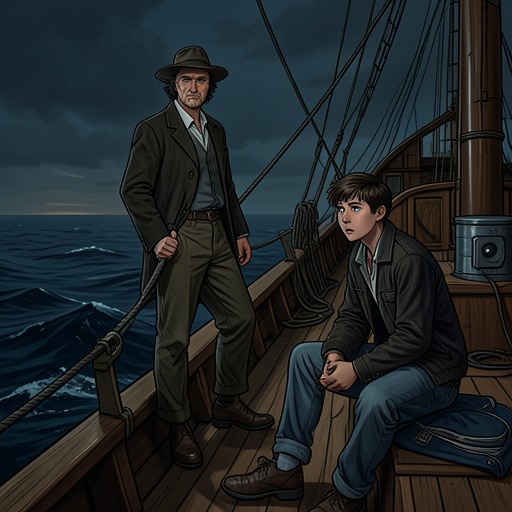
The poem presents the Ancient Mariner first through an encounter rather than a history. He is “an ancient Mariner” who stops one of three people on their way to a wedding; his grey beard and glittering eye identify him to the Wedding-Guest before his account explains what made him a figure apart. The opening thus establishes both his physical age and his unusual power over a listener: the journey begins as an interruption of an ordinary celebration.
Within the tale, the Ancient Mariner speaks from the position of a survivor. He recalls the crew’s departure, the ship’s encounter with a violent storm, and the events that transform a voyage into an ordeal. His narrative is not simply a report of what happened at sea: in the present, the Wedding-Guest asks what manner of man he is, and the Ancient Mariner’s body is wrenched by agony before the tale is forced from him. The storyteller is therefore also a person compelled by the consequences of what he tells.
Voyage and the Albatross
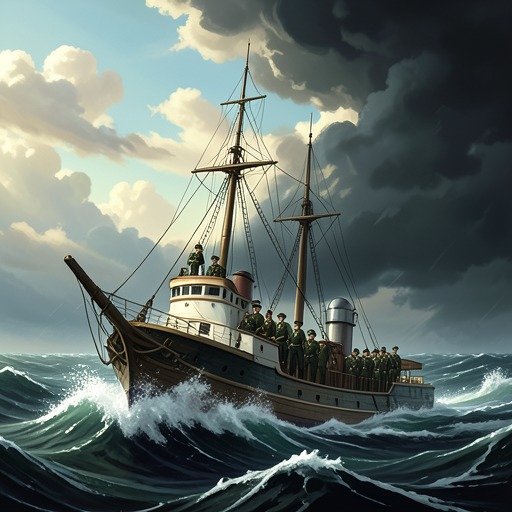
The voyage begins with the ship leaving harbour amid the crew’s cheers. That communal, purposeful departure supplies a sharp contrast to what follows: the STORM-BLAST arrives as a tyrannical force and drives the ship onwards. The Ancient Mariner’s story binds human seamanship to powers beyond the crew’s command, while retaining the practical details of the vessel’s movement and work.
After the ice splits and the helmsman steers the ship through, a good south wind rises behind it. The Albatross follows, coming each day for food or play. The bird’s arrival belongs to the voyage’s movement from danger toward passage through the ice; the crew encounters it as a living presence alongside the ordinary business of sailing. Against this background, the Ancient Mariner’s use of a Crossbow to shoot the bird becomes the decisive act associated with his subsequent affliction and penance.
The poem makes the contrast between the bird’s presence and its killing consequential without supplying a further motive in these moments. The ship and crew have passed through the ice, and a south wind has begun to carry them onward; the Albatross follows them. The Ancient Mariner’s shot interrupts that sequence. The act is not presented as a necessary step in navigation, but as the deed from which his account of suffering and moral change takes its force.
Change Through the Living Creatures
The Ancient Mariner’s transformation is registered in his response to the water-snakes. Their tracks appear as flashes of golden fire, and he recognizes their beauty with a love that rises spontaneously in his heart. The moment matters because it is not described as a calculated effort to escape punishment. His changed relation to other living things arrives as an unforced response to what he sees.
That blessing marks a reversal in the emotional course of the tale: the Ancient Mariner, who has committed the act against the Albatross, can now perceive and love creatures he had not valued in this way. The poem connects this inward movement to the possibility of prayer, and to the Albatross’s fall from his neck. The change does not erase the earlier deed or immediately release him from its effects; instead, it becomes a turning point within an ongoing penance.
Later, the ship moves despite the absence of a breeze. The helmsman steers, and the mariners work the ropes, so the voyage proceeds through the visible labour of the crew even when wind no longer explains its motion. The Ancient Mariner recalls a scene that sounds almost like a dream in which the dead rise, yet the ship’s movement and the work aboard it are stated plainly. The contrast between practical tasks and uncanny circumstances defines the world his narrative asks the listener to enter.
Return, Compulsion, and Legacy
Near the end of the voyage, the Ancient Mariner hears the dash of oars and the Pilot’s cheer. The sounds announce an approaching rescue and bring him back toward human company. They do not conclude his suffering: as the Wedding-Guest asks who he is, an agony wrenches the Ancient Mariner’s frame and forces him to begin his tale. Rescue from the sea and release from the compulsion to speak are not the same thing.
The story’s frame makes retelling part of the Ancient Mariner’s condition. He does not choose a celebratory audience or a calm moment for recollection; he stops a wedding-bound passerby, and bodily pain drives him to speak. The Wedding-Guest is consequently more than a recipient of sea adventures. The Ancient Mariner’s account interrupts his journey to the wedding, and the final address singles him out as the person to whom the moral and farewell are delivered.
The Ancient Mariner ends by directing that teaching toward the Wedding-Guest: the words about loving living things follow his farewell to people of different ages and relationships. The poem’s final principle grows out of the change already shown in his recognition of the water-snakes’ beauty. His story joins the shooting of the Albatross, the suffering that follows, and the capacity to love creatures as parts of one moral history. The Wedding-Guest leaves as a sadder and a wiser man; the Ancient Mariner remains the teller whose painful experience has made that change possible.